








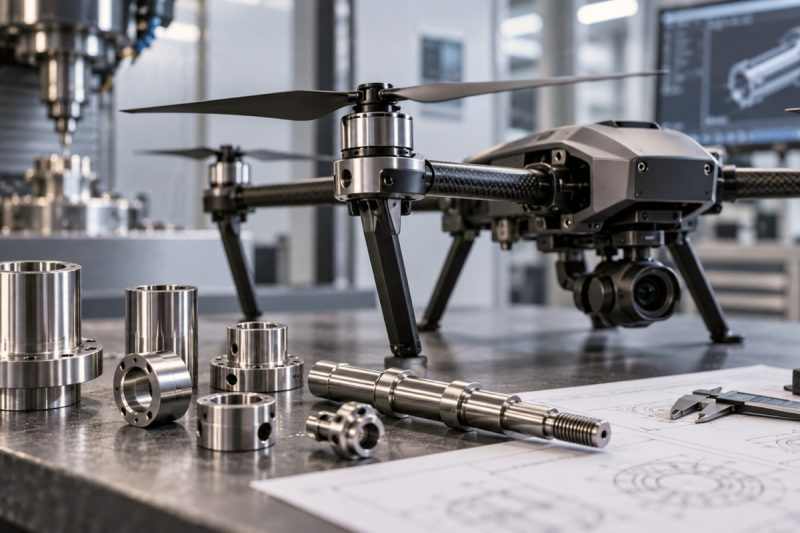
In the design of an unmanned aerial vehicle, every gram removed from the structure translates into flight endurance, payload capacity and dynamic responsiveness. Mass that does not weigh on the frame is mass available for the battery or the payload. It is energy the motors do not have to spend keeping the aircraft in the air. This constraint shapes the entire production chain and makes the turning of drone components a balancing act between weight reduction, mechanical strength and dimensional stability.
Why drone components require a different production approach
A drone is a lightweight structure subjected to high-frequency cyclic loads. Rotors typically run between 4,000 and 12,000 rpm and transmit constant vibration to the structure. In-flight manoeuvres also introduce bending and torsional loads on arms, joints and mounts. There is also a significant thermal cycle to consider, caused by the heating of motor windings and ESCs. In agricultural or marine applications, drone components are exposed to moisture, abrasive dust and chemical agents.
Turned parts intended for this sector cannot be treated as generic small parts. Each part must combine reduced cross-sections and thin walls with predictable structural behaviour, and it must hold its geometry after machining and treatment. Consistent mass must also be guaranteed batch after batch. Weight differences between symmetrical drone components create imbalances that the flight control system has to compensate for, which costs energy and causes uneven wear.
Materials for drone components: density, strength and machinability
Material selection is the first factor that determines the weight-to-performance ratio of drone components.
Aluminium alloy drone components
6000-series aluminium alloys, in particular 6082-T6, are the standard for most turned structural parts. They offer a density of around 2.70 g/cm³, good mechanical strength, excellent machinability and outstanding suitability for anodizing.
Arm mounts, rotating joints and gimbal shafts carry higher specific loads. For these drone components, 7000-series alloys such as 7075-T6 are used, offering ultimate tensile strength above 500 MPa at the same density. Their lower corrosion resistance almost always makes a protective surface treatment necessary.
Brass and bronze drone components
Brass and bronze keep a well-defined role even in a context dominated by an obsession with weight. Electrical contacts, bushings, power terminals, sliding seats and other drone components that require electrical conductivity or low friction find the technically correct solution in copper alloys. Their higher density is offset by small dimensions and by functional performance that aluminium cannot deliver.
Likewise, austenitic stainless steels and alloy steels remain essential for pins, shafts, fasteners and parts subject to wear or concentrated loads. In these drone components, stiffness and fatigue resistance take priority over weight.
Titanium drone components
Titanium and its alloys are the benchmark choice for the most highly stressed components, where the strength-to-weight ratio has to be pushed to the limit. They offer intermediate density, high tensile strength and excellent corrosion resistance. The cost of the raw material and of machining limits their use to critical parts or niche production runs.
Bar turning and weight-reduction strategies
In the production of drone components, the real quality differentiator is not the choice of material but the way it is machined. Structural weight reduction is achieved through internal hollowing, reduced cross-sections, pockets and thin walls that bring the part close to its deformation limit during machining itself.
A profile with a wall thickness below one millimetre tends to deflect under tool pressure, heat up unevenly and release residual stresses once freed from clamping. The result is a part that passes dimensional inspection and then, after a few hours or after heat treatment, no longer does.
Controlling this behaviour depends on variables that come from machining experience. Tool geometry and sharpness, cutting parameters and progressive roughing strategies all matter, because they distribute chip removal instead of concentrating it. High-pressure coolant, which limits the thermal gradient, is just as important. So are machining sequences that keep the part supported for as long as possible.
Machines for turning drone components
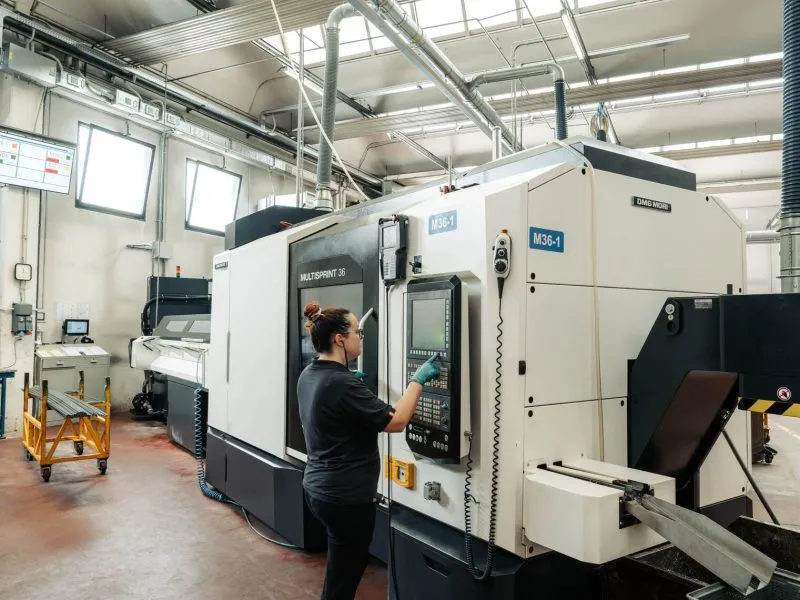
The machine configuration used to turn drone components is equally decisive.
Swiss-type lathes (sliding headstock lathes) can machine long, slender parts while keeping the cutting point close to the guide bushing. They reduce deflection and ensure high concentricity at critical length-to-diameter ratios.
CNC turning centres with live tooling complete milling, cross-drilling, threading and profiling in a single setup. This eliminates the repositioning errors that, on a motor mount, would result in misalignment between the bearing seat and the mounting face.
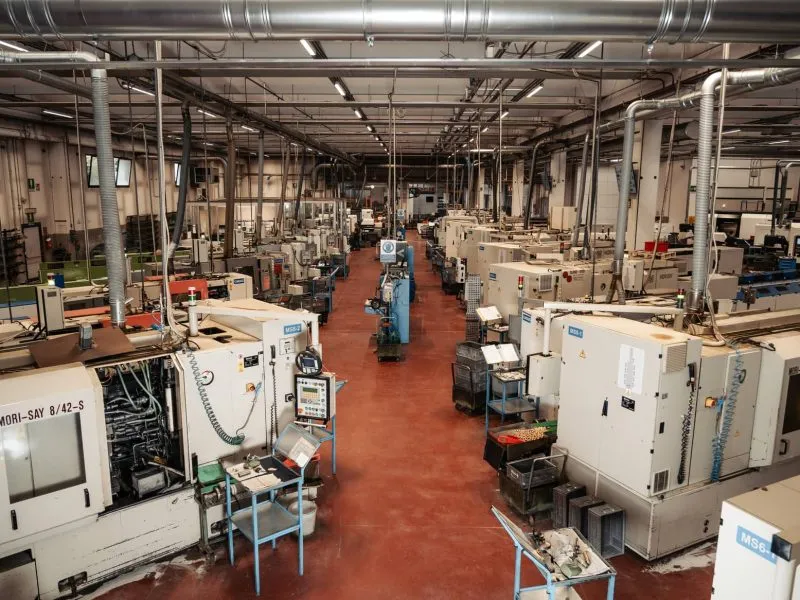
Finally, multi-spindle lathes make series production economically viable. They maintain dimensional consistency over high volumes, which is essential when the same drone component is fitted in four, six or eight symmetrical positions on the same aircraft.
Tolerances, concentricity and dynamic behaviour
In rotating drone components, or in those that house rotating parts, quality is measured in terms of geometric error rather than nominal dimension. Bearing seats, shoulders and datum faces must be controlled for concentricity and perpendicularity relative to the axis of rotation. The absence of play and the uniformity of load depend on this. Every deviation adds to the residual imbalance of the propeller and increases the vibration transmitted to the structure.
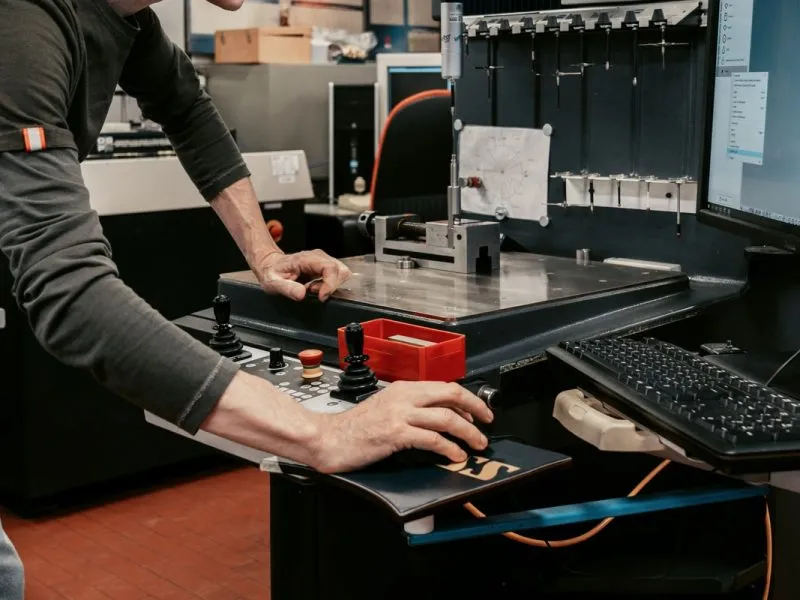
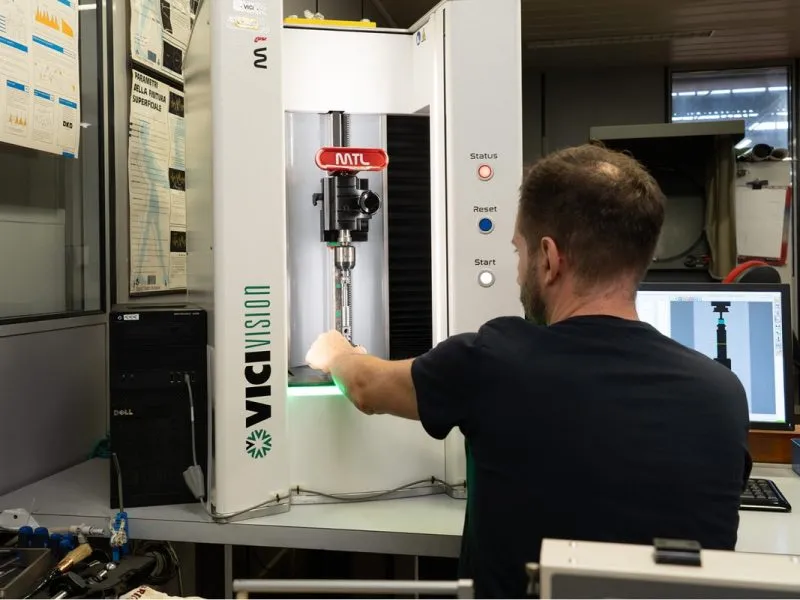
This issue is especially sensitive because vibration does not only degrade the mechanics. It also interferes with the accelerometers and gyroscopes of the inertial measurement unit, introduces noise into navigation data and compromises image stabilization in camera systems. A mechanically precise component improves the quality of the data acquired. For this reason, flatness, perpendicularity and surface roughness specifications for drone components must be defined on the drawing and verified with instruments, not inferred from a generic tolerance class.
Surface treatments and in-service resistance
On aluminium parts, hard anodizing substantially increases wear and corrosion resistance without significantly affecting mass. However, its dimensional effect must be taken into account. The anodic layer grows both outward and inward into the substrate, changing final dimensions by about half the nominal thickness. On precision fits, this variation has to be compensated for during machining.
For stainless steels, passivation restores the protective film altered by machining. On alloy steels and copper alloys, the choice between zinc plating, electroless nickel plating or specific coatings depends on the operating environment and on the presence of electrical contacts or couplings between dissimilar materials.
Final cleaning using ultrasonic technology or vacuum cleaning with modified alcohols completes the cycle. It ensures that no oily or particulate residues remain on drone components that come into contact with electronics, bearings and optical systems.
Sarbo: your drone components manufacturer in Italy
Sarbo is a leading partner in precision automatic turning and a trusted manufacturer of drone components and precision turned parts. More than fifty years of activity have built know-how that is reflected in a diversified machine park well suited to manufacturing UAV components.
Swiss-type lathes produce slender pins and shafts while maintaining high concentricity. CNC turning centres complete motor mounts and flanges in a single setup, combining turning, cross-drilling and threading. Multi-spindle technology makes volumes sustainable when the same part must be replicated across several arms of the aircraft.
Experience gained in sectors where tight tolerances and continuity of supply are the norm, from automotive to medical, is highly valuable in the production of CNC turned drone parts as well. It translates into the ability to handle extreme weight reduction, close-tolerance fits and surface cleanliness requirements.
Contact us for more information.
FAQ on turning drone components
The answer depends on the function of the part.
For structural elements such as motor mounts, spacers, arm joints and flanges, the choice generally falls on aluminium alloys. 6082-T6 offers the best balance of machinability, cost and strength, while 7075-T6 is used where specific load or cross-section constraints demand higher mechanical properties.
For electrical contacts, bushings, terminals and sliding seats, brass and bronze remain technically irreplaceable, thanks to conductivity and tribological behaviour that aluminium cannot match.
Pins, shafts and parts subject to wear or concentrated loads are made from stainless or alloy steel, accepting higher density in exchange for stiffness and fatigue resistance.
Titanium is used for critical components on professional platforms, where the strength-to-weight ratio justifies the cost.
The right criterion is not to find the lightest material in absolute terms. It is to find the one that allows the minimum cross-section compatible with the expected load and the machining cycle.
The first criterion is the match between the machine park and the type of part to be produced. A slender, high-concentricity drone component requires Swiss-type lathes. A part that combines turning and milling requires turning centres with live tooling. High-volume series production requires multi-spindle technology.
The second indicator is metrology capability: suitable measuring instruments, formalized inspection procedures and documented results.
The third parameter is cycle integration. A supplier that manages treatments, cleaning, inspection and logistics in-house or through qualified partners reduces the number of contacts, lead times and the risk of responsibilities being scattered.
The fourth factor, often the decisive one, is the supplier’s approach during industrialization. A partner that analyses the drawing, flags manufacturability issues and proposes optimizations before production starts prevents costs and delays that would otherwise emerge once the series is already under way.
The motor mount is a component where geometric, structural and mass requirements converge.
In design practice, it is usually made from 6082-T6 or 7075-T6 aluminium alloy. Mounting hole spacing follows the most common brushless motor standards, typically 16×16, 19×19 or 25×25 mm. Holes for M3 metric screws are made to H8 tolerance, or threaded directly into the part when the thickness allows.
The bearing or shaft seat requires H7 tolerance. Concentricity relative to the datum axis should be kept within 0.02 mm, with a surface roughness of around Ra 0.8 µm. The motor mounting face must have a perpendicularity of 0.03 to 0.05 mm relative to the same axis. Beyond that limit, the angular error results in rotor misalignment.
For weight-reduction features, residual wall thicknesses between 0.8 and 1.5 mm can be achieved with good repeatability, provided the machining cycle includes balanced roughing and proper management of residual stresses. The reference surface treatment is hard anodizing between 10 and 20 µm.


 Back to top