








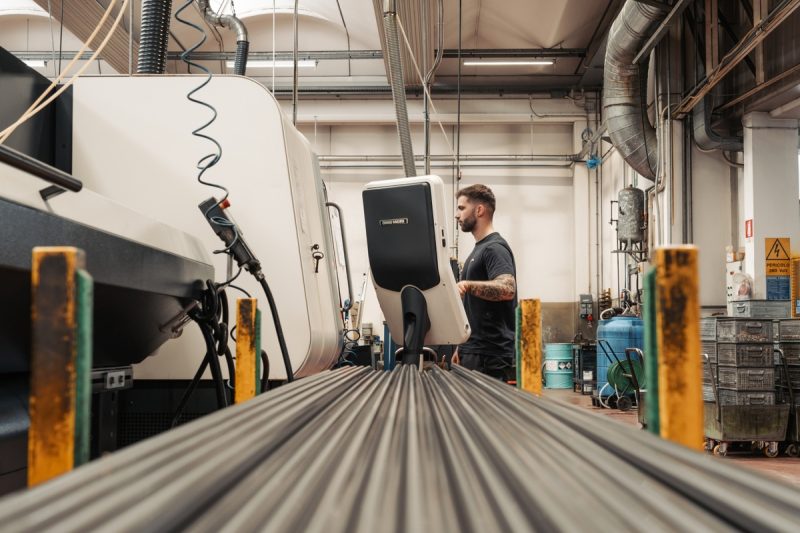
Advanced turning on next-generation lathes can run a complete, integrated cycle. The workpiece goes in as raw bar stock and comes out finished, ready for assembly. This removes the downtime between production stages and the need for manual repositioning, with clear gains in lead times, costs, quality and supply organisation.
What advanced turning means today
Today, advanced turning is no longer just about tight tolerances. It is the ability to turn raw stock into a finished part in a single cycle.
Next-generation lathes combine live tooling, a Y axis, a sub-spindle and automation systems. They can perform turning, milling, drilling (radial and axial), threading and gear cutting, and they can complete the back side of the part as well. None of this requires operator intervention.
The CNC control drives multiple axes in perfect synchronisation. Digital simulation verifies toolpaths and prevents collisions at the programming stage, before the machine starts. The result is a highly predictable, traceable and repeatable process.
This approach is known as single-setup machining. It is the principle behind the whole evolution of advanced turning.
A single setup eliminates repositioning errors
Every time a part is unclamped and clamped again, an error is introduced. This is not a machining defect but a physical consequence of clamping: the new reference never matches the previous one exactly. On loose tolerances the effect is negligible. On close-tolerance fits it becomes decisive.
Completing the part in a single setup means keeping one reference system from start to finish. Concentricity, coaxiality and perpendicularity are guaranteed by design, not by later correction.
In advanced turning, this benefit adds to the economic one. Every step removed means one less setup, one less handling operation and one less intermediate inspection. On high-volume runs the cumulative effect is significant.
CNC multi-spindle lathes: working in parallel, not in sequence
The multi-spindle lathe is the most effective answer when volumes grow. Its logic differs from that of a conventional lathe. On a single-spindle machine, operations follow one another: the part is roughed, then finished, then drilled, then threaded. Cycle time is the sum of all operations.
On a CNC multi-spindle lathe, the spindles index through fixed stations. Each station performs a different operation on a different part at the same moment. Cycle time is no longer the sum of the operations but the duration of the longest one.
The difference in output is substantial. A part that takes forty seconds on a single-spindle lathe can come off a multi-spindle machine every six or seven seconds. Quality stays the same and dimensional consistency improves, because every part follows exactly the same path.
CNC advanced turning machines have overcome the historical limit of this technology. Mechanical multi-spindle lathes require longer, more complex setups, justified only on very large batches. CNC drastically cuts changeover times. Today the same machine can handle different part numbers with quick reprogramming, making the technology viable for medium-sized runs too.
The integrated robotic arm: automation inside the cycle
What sets the latest machines apart is a robotic arm integrated inside the working area.
In advanced turning, this system picks up the part once front-side machining is complete. It transfers it to the sub-spindle while keeping its orientation, and presents it to the tools for back-side operations. Finally, it places it on a conveyor or in a container, already separated and in order. The robot follows the same path every cycle, at the same speed and with the same grip, so the variability of manual handling disappears from the process.
With robotic handling, the back of the part becomes as accessible as the front. Shoulders, seats, holes and threads can be machined on the opposite side without a second manual setup.
Parts are not dropped loose into a bin. They are placed with a controlled movement. On finished, polished parts or parts with critical surfaces, this eliminates dents and micro-damage that would otherwise create scrap.
An advanced turning system with an integrated robotic arm can also run autonomously over extended shifts, including unmanned ones. Productivity no longer depends on having an operator at every machine.
Live tooling and Y axis: beyond rotational symmetry
Conventional turning produces rotational geometries. Anything off-axis requires a different machine.
Advanced turning removes this constraint. Live tools are built into the turret, have their own drive and work with the spindle stopped or in a controlled position. They allow milling, slots, flats, gear cutting and off-centre drilling.
The Y axis extends the possibilities further. It lets the tool move outside the diametral plane, making off-centre pockets, angled holes and complex profiles possible.
A part that once needed a lathe, a milling machine and a drill press now comes out complete from a single machine with advanced turning.
Process monitoring and in-line dimensional control
Advanced turning is not only about removing chips. It is also about measuring and correcting in real time.
Monitoring systems detect spindle load, tool wear and cutting anomalies. A tool that is starting to deteriorate is flagged before it produces out-of-tolerance parts.
In-line dimensional control completes the picture. Probes and optical systems check critical dimensions during the cycle, automatically compensating for thermal drift and wear.
OEE monitoring measures the availability, performance and quality of each machine. The data collected show where the real losses are and how to act on them. For the customer, advanced turning means more reliable delivery times and verifiable process documentation.
Sarbo and advanced turning: CNC turning centres with robotic arm
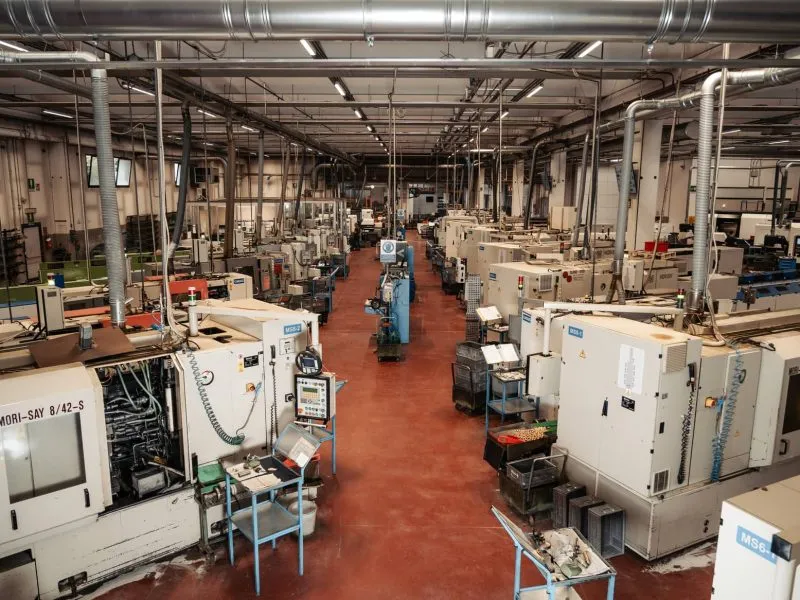
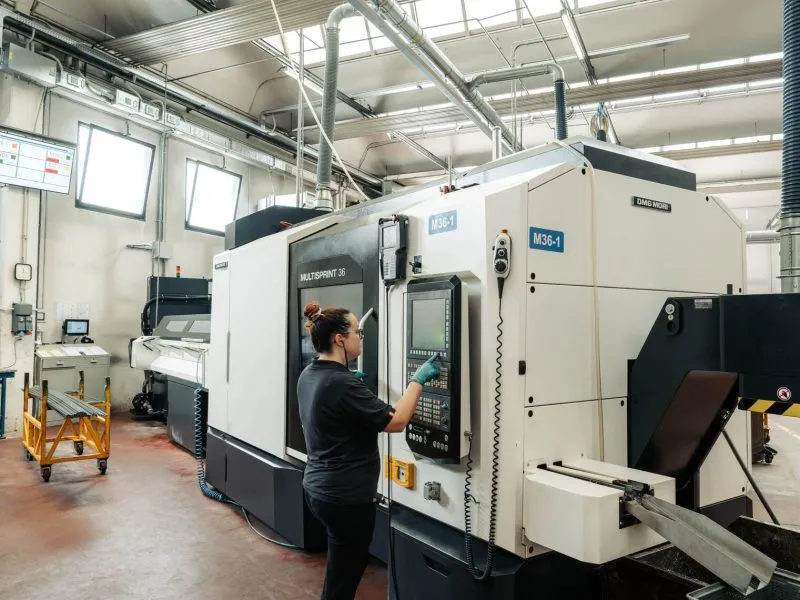
Sarbo operates CNC turning centres that machine several parts in parallel on separate spindles, keeping cycle times extremely short and dimensions consistent across large runs. Alongside them is the Multisprint 36 CNC multi-spindle lathe, the latest expression of advanced turning, with six synchronised spindles and integrated numerical control.
On this machine, the integrated robotic arm is part of the cycle. The front and back of the part are completed in the same operation, with no manual repositioning and a single starting reference. Dimensions linking the two sides are guaranteed by design. Controlled part placement protects finished surfaces, a requirement that becomes essential on polished parts or parts intended for precision fits.
The machine fleet also includes CNC twin-spindle lathes, Swiss-type (sliding headstock) lathes and CNC bar-fed transfer machines.
Being a company specialised in advanced turning also means building quality control into the production process. Sarbo operates in compliance with ISO 9001:2015 certification, with standardised operating methods and advanced measuring equipment. Dimensional inspection is not left to the end of the batch. It runs alongside production, from in-machine checks during the cycle to final inspection of the part ready for shipping.
Contact us for more information on advanced turning.
Advanced turning FAQ
The medical sector sets requirements that few machining processes can meet all at once. Precision turning delivers on three fronts.
The first is dimensional. Surgical instruments, components for implantable devices and parts of diagnostic equipment require tight tolerances and high-quality surface finishes. Low roughness is not an aesthetic requirement: it reduces bacterial adhesion and improves compatibility with sterilisation processes.
The second is consistency. In the medical field, every part must conform, every time. Single-setup machining and in-line dimensional control ensure the last part of a batch matches the first.
The third is traceability. Every batch must be traceable to its process parameters and inspection reports. A supplier with a certified management system provides this documentation as part of the supply.
Many medical components combine complex geometries with small dimensions. Producing them on a single machine reduces handling, and with it the risk of contamination and damage.
Composite materials behave very differently from metals. The first issue is that they do not form continuous chips: the material fractures instead of deforming plastically. This leads to typical defects. Delamination between layers is the most critical, because it weakens the structure without always being visible. Fibre fraying along edges and micro-cracks in the matrix also occur.
The second issue is tool wear. Carbon and glass fibres are highly abrasive. Conventional inserts wear quickly, so polycrystalline diamond (PCD) tools or tools with specific coatings are needed.
The third concerns heat. The polymer matrix degrades at relatively low temperatures. Yet conventional coolant is not always an option, because some composites absorb moisture. Parameters must therefore limit heat at the source, often with high cutting speeds and low feed rates.
The guiding principle is that the robot must be designed together with the cycle.
The first best practice concerns gripping. The gripper must be designed around the actual geometry of the part and the surfaces that can be touched without damage.
The second concerns handling time. Transfers must fit within the masked time of the cycle, meaning they happen while the machine is cutting. If the robot lengthens the cycle, the investment will not deliver the expected benefit.
The third concerns anomaly handling. The system must detect a missing part, a failed grip or an unexpected obstacle, and respond by stopping in a safe condition. Presence sensors and force control on the gripper are essential.
The fourth concerns safety and restart logic. It must be clearly defined what happens on restart after a stop, where the part in process is and how the cell state is restored.
Finally, upstream and downstream flow must be considered. A robot integrated into the machine is only effective if bar feeding and outgoing container handling are automated to the same level. A cell’s productivity is measured by the weakest link in the chain.


 Back to top