








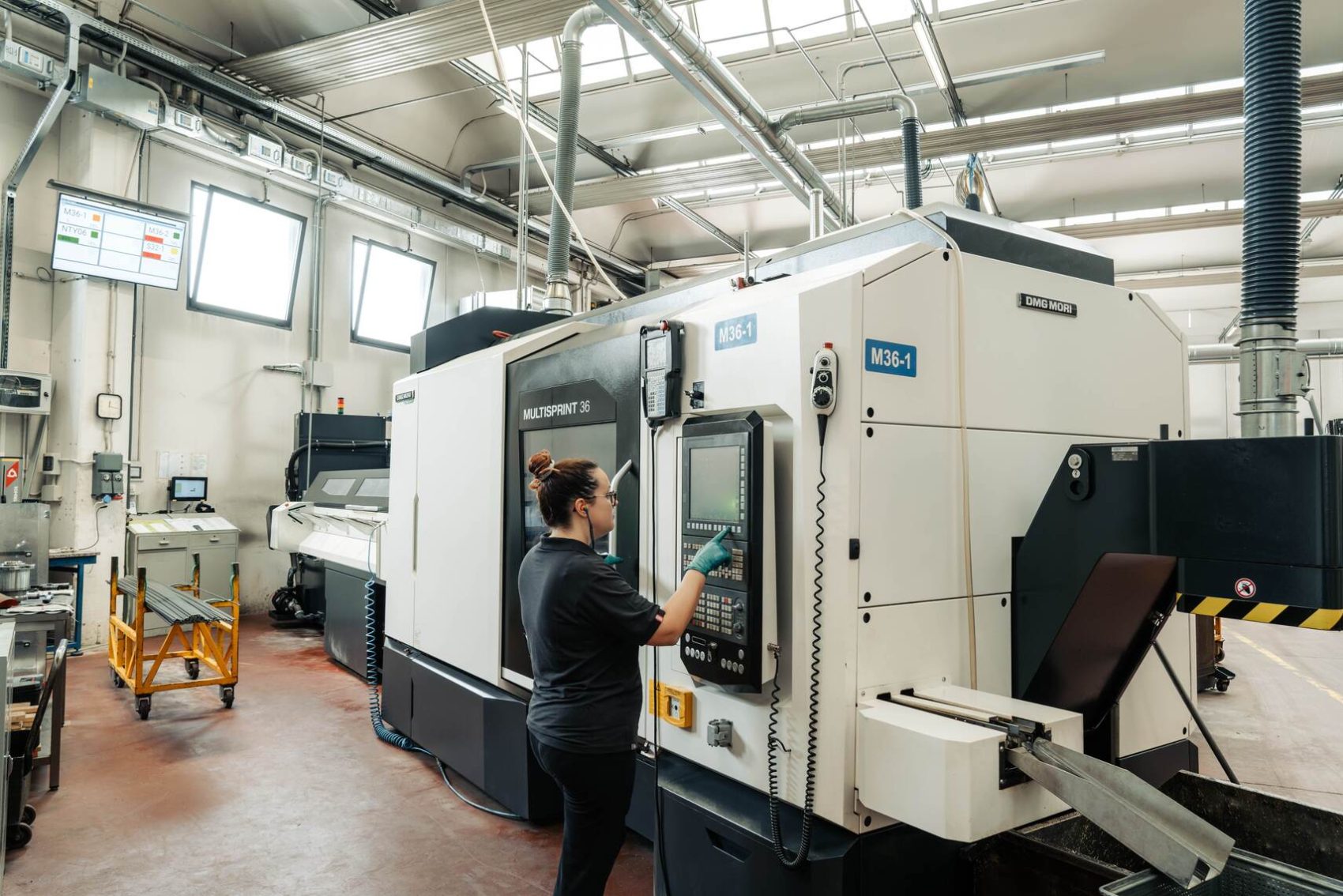
Multi-spindle turning with multi-axis capabilities is one of the most advanced manufacturing solutions for producing custom metal components in highly competitive industries such as automotive, hydraulics, medical devices, and pneumatics. In these sectors, the ability to manufacture high-precision mechanical parts in large volumes while minimizing cycle times and reducing unit costs is a critical factor in maintaining competitiveness and ensuring production continuity.
The Evolution of Multi-Spindle Turning
Modern machines used in multi-spindle turning have moved beyond the traditional concept of high-volume production, evolving into highly sophisticated systems capable of performing simultaneous multi-axis machining operations.
This evolution makes it possible to perform multiple operations within a single production cycle, tasks that once required several machining stages and different machines. Axial and cross drilling, tapping and threading, milling, grooving, and broaching can all be integrated into the same process, dramatically reducing downtime and minimizing the risk of errors.
The fundamental principle of a multi-spindle lathe is the simultaneous machining of multiple workpieces across several spindles, each operating at a different stage of the production cycle. While one part is undergoing rough machining, another is already being finished, a third is undergoing axial drilling, and a fourth is being prepared for unloading. This parallel machining approach, often referred to as an overlapping production cycle, significantly reduces machining time. As a result, multi-spindle turning offers exceptional efficiency, enabling high-volume production without compromising precision.
Multi-Axis Integration: A Tangible Competitive Advantage
Multi-spindle lathe with multi-axis capabilities makes it possible to consolidate multiple operations into a single production cycle, eliminating the need for additional machining processes. This results in a significant reduction in operating costs and greater process repeatability, an essential advantage for manufacturers handling large production runs. At the same time, the ability to manage complex geometries expands the range of possible applications, enabling manufacturers to respond more flexibly to evolving market demands. Technical components requiring intricate machining operations can be produced through multi-spindle turning with precision and consistency, while maintaining tight tolerances and high quality standards. This allows companies to meet increasingly complex market requirements with greater flexibility, without sacrificing efficiency.
Sarbo: Where Technology and Vision Drive Production
Sarbo is a multi-spindle turning company specialized in the production of custom precision-turned metal components, capable of working with a wide range of materials. Alongside its consolidated experience with mechanical multi-spindle lathes, the company has invested in next-generation CNC multi-spindle lathes equipped with robotic arms. This solution enables full programmability of all machining parameters. Spindle rotation speed, feed rates, depth of cut, tool paths, and axis synchronization are all defined digitally and can be recalled instantly when switching production batches.
The transition from one component to another on CNC machines is significantly more flexible and faster than on purely mechanical setups. Machine setup, while still involving both software programming and the physical installation and adjustment of tools, helps optimize changeover times and enables the management of more complex and varied production mixes. In some cases, these adjustments can be completed within the same day.
By contrast, on mechanical multi-spindle machines, the same operations require more complex interventions and considerably longer setup times.
The robotic arm integrated into multi-spindle turning systems adds another level of automation by handling the loading and unloading of components, reducing the need for manual intervention in material handling. This enables extended unattended production cycles, greater operational continuity, and reduced non-productive time.
Learn more about materials used in multi-spindle turning.


 Back to top